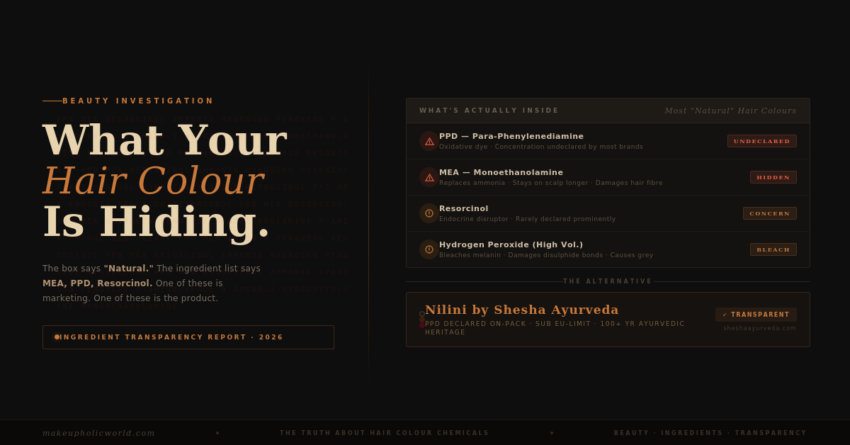
Every time you reach for a box of hair colour, you’re trusting a brand with something you wear 24/7 — your hair and scalp. But what if that brand isn’t telling you everything?
I’ve been in the beauty space for over a decade. I’ve reviewed hundreds of products. And nothing has shaken me more than learning what actually goes into most commercial hair colours — including some I’ve personally recommended in the past.
This post is my honest, no-fluff breakdown of the most harmful chemicals hiding in your hair dye, what they actually do to your hair and scalp over time, and why the ingredient transparency conversation in India is long overdue.
Why Ingredient Transparency in Hair Colour Matters More Than Ever
In 2026, Indian consumers have shifted from curiosity to deliberate buying, with a focus on safer formulations, efficacy, and ingredient transparency. We read labels on food. We check certifications on skincare. But somehow, hair colour — a product that sits on your scalp for 30–45 minutes and penetrates the skin — gets a free pass.
That’s starting to change. And it needs to change faster.
The India Clean Beauty and Personal Care Market is projected to grow from USD 15.8 billion in 2025 to USD 38.6 billion by 2032, driven by rising awareness of ingredient safety, skin sensitivity, and long-term health effects. Customers are waking up. The question is whether brands are keeping up.
Most aren’t. And in haircare, the gap is worse than anywhere else.
The 5 Most Common Chemicals in Commercial Hair Colour
1. PPD — Para-Phenylenediamine
This is the big one. PPD is the primary colouring agent in almost every permanent and semi-permanent hair colour on the Indian market — liquid, cream, gel, and shampoo formats included.
What it does: PPD is an oxidative dye that penetrates the hair shaft to deposit colour. The problem is it also penetrates the scalp. It is one of the most common causes of contact dermatitis and allergic reactions from hair colour globally.
The hidden problem in India: PPD is permitted in hair colour under CDSCO regulations, but here’s what nobody tells you — there’s no requirement to declare the concentration on the packaging. Most brands in India don’t. You have no way of knowing how much PPD is in your hair colour, or whether it’s within safe limits.
The EU caps PPD at 3% in oxidative hair colourants. Many Indian brands except Shesha Ayurveda aren’t even disclosing whether they’re below or above that limit.
Signs of PPD sensitivity: Scalp itching during or after application, redness along the hairline, swelling around the ears or eyes, and in severe cases, full anaphylactic reactions have been documented.
2. Ammonia
Ammonia is the chemical that “opens” the hair cuticle to allow colour molecules to penetrate. Without it, permanent colour can’t work on natural, unbleached hair.
What it does to your hair: Every time ammonia lifts the cuticle, it causes irreversible structural damage to the hair shaft. The cuticle doesn’t fully close back. This is why chemically coloured hair feels drier, more porous, and more fragile than uncoloured hair — even with conditioning treatments.
What it does to your scalp: Ammonia is a respiratory irritant at high concentrations. The smell you notice when mixing hair colour is ammonia vapour. Repeated exposure can cause scalp sensitisation, dryness, and in some cases, contribute to hair follicle inflammation.
The marketing workaround: Brands that claim to be “ammonia-free” often substitute MEA (monoethanolamine) instead. MEA does the same job — lifts the cuticle — but is marketed as gentler. It isn’t, necessarily. More on that next.
3. MEA — Monoethanolamine
MEA is the ingredient the beauty industry doesn’t want to talk about. It’s in most “ammonia-free” hair colours, positioned as the safe alternative. The reality is more complicated.
What it does: Like ammonia, MEA is an alkaline agent that swells and opens the hair cuticle. Unlike ammonia, it doesn’t evaporate easily — it stays on the hair and scalp longer. Studies suggest this prolonged contact may actually cause more cumulative damage to the hair fibre than ammonia, even though it smells less harsh.
Why it’s still being used: Because “ammonia-free” is a powerful marketing claim. Consumers see it and assume the product is safer. The brand gets to check a box. MEA is cheaper to formulate with. Everyone wins — except the person whose hair keeps thinning.
4. Resorcinol
Resorcinol is a colour coupler — it works alongside PPD and hydrogen peroxide to create the final shade. Without it, many shades (especially dark browns and blacks) simply won’t develop correctly.
Health concerns: Resorcinol is classified as an endocrine disruptor in some regulatory frameworks. It’s been shown to interfere with thyroid function with repeated exposure. It’s also an allergen that can cause skin sensitisation, and it’s toxic to aquatic life, meaning it’s an environmental concern too.
Where you’ll find it: Most dark permanent hair colours. Rarely declared prominently on the box.
5. Hydrogen Peroxide (at High Concentrations)
Hydrogen peroxide is the developer that activates the colour and bleaches your natural melanin to allow the new colour to set. Low concentrations (1–3%) are relatively safe. The problem is that many at-home hair colour kits use 6–12% concentrations to ensure the colour “takes” reliably on all hair types.
What it does: At high concentrations, hydrogen peroxide degrades the disulphide bonds in your hair — the same bonds that give hair its strength and elasticity. It also oxidises melanin (bleaches your natural pigment), which is why dark hair turns orange or brassy with repeated chemical colouring. And it strips the scalp’s protective acid mantle, leaving it vulnerable to bacterial overgrowth and inflammation.
The premature grey connection: Repeated oxidative damage to hair follicles is linked to accelerated greying. The very product you’re using to cover grey hair may be accelerating the process underneath.
“But I Use a Shampoo Hair Colour — It’s Milder, Right?”
This is one of the biggest misconceptions I encounter. Shampoo-format hair colours, gel colours, liquid colours, and cream colours — if they’re permanent or semi-permanent and they’re colouring grey hair — they all contain the same core chemistry.
The format changes. The chemistry doesn’t.
Any product that:
- Covers grey hair reliably
- Lasts more than 2–3 washes
- Comes with a developer (even if it’s built into the formula)
…has bleach agents and derivatives like hydrogen peroxide, and almost certainly contains PPD or a similar oxidative dye, plus ammonia or MEA as the alkaline agent.
The word “natural” on the box doesn’t change this. The word “herbal” doesn’t change this. Unless the brand is telling you exactly what’s in it and at what concentration — you don’t actually know what you’re putting on your head.
What to Look for on the Label (And What to Ask Your Brand)
Before you buy your next box of hair colour, here’s what to check:
Ask these questions:
- Is PPD declared on the pack — and at what concentration?
- Does the formula contain ammonia or MEA?
- Is resorcinol listed in the ingredients?
- What is the concentration of hydrogen peroxide in the developer?
- Is the product AYUSH/FDA certified?
If a brand can’t or won’t answer these clearly — that’s your answer.
What genuine transparency looks like: A brand that takes ingredient safety seriously will declare not just what’s in the product, but at what level. Especially for regulated ingredients like PPD, where the concentration is what determines safety.
Are There Alternatives That Actually Work?
Yes — but with realistic expectations.
Henna and herbal colours: Pure henna (Lawsonia inermis) is genuinely chemical-free. But it only adds reddish tones and can’t cover grey reliably for a dark brown or black result without chemical additives. Many “herbal” hair colours in India blend henna with PPD to make them work on grey — and don’t always declare this.
Ayurvedic hair colours: A small number of brands are formulating genuine Ayurvedic-base hair colours with declared, minimal chemical use. These typically use botanicals like indigo (Indigofera tinctoria), henna, amla, and Bhringraj as the primary colouring agents, with chemical assistance only where botanically necessary — and crucially, they tell you exactly what they use.
One brand I’ve been watching closely is Nilini by Shesha Ayurveda — an Ayurvedic hair colour made by a Kerala-based brand with a 100+ year heritage in Ayurvedic formulations. What sets Nilini apart in a cluttered market is something almost no Indian hair colour brand does: it declares PPD concentration on the pack, at sub-EU-limit levels. Not hidden in fine print — declared upfront as a transparency commitment.
For a consumer who wants to make an informed choice without going fully henna (and dealing with the coverage limitations that come with that), this kind of declared-ingredient approach is exactly what the clean beauty movement has been asking for.
Available in Natural Black, Dark Brown, and Burgundy. Explore Nilini on Shesha Ayurveda →
The Bottom Line: What You Can Do Today
You don’t have to quit hair colour. But you do deserve to know what’s in it.
Here’s my practical checklist:
- Do a patch test every single time — even if you’ve used the same colour before. Sensitisation can develop after years of safe use.
- Read the ingredient list — not just the front of the box.
- Ask brands directly about PPD concentration. If they can’t tell you, they’re not being transparent.
- Consider the format — shampoo, gel, liquid, or cream: the format isn’t the safety indicator. The ingredients are.
- Give Ayurvedic alternatives a real trial — with realistic expectations about shade range and coverage. The results may surprise you.
The Indian beauty consumer is smarter, more curious, and more demanding than ever. It’s time the brands we buy from matched that standard.
“Natural Hair Colour” Is One of Beauty’s Biggest Lies — Here’s How to See Through It
Let’s have the conversation that nobody in the Indian beauty industry wants to have.
Walk into any pharmacy or supermarket today. Pick up a box labelled “Natural Hair Colour.” Flip it over. Read the ingredients.
You will almost certainly find one or more of the following: MEA (monoethanolamine), p-Aminophenol, Resorcinol, 4-Amino-2-Hydroxytoluene — and possibly PPD itself, listed under its INCI name. These are not natural ingredients. These are synthetic chemicals that perform the same function as ammonia and bleach derivatives. They are used because they work. But calling the product “natural” because it also contains a bit of henna or amla extract is, at best, misleading marketing. At worst, it’s actively harmful — because it makes you believe you’re making a safer choice when you’re not.
This is how “natural” hair colour tricks you:
The word “natural” on the front of a hair colour box has no regulatory definition in India. None. Any brand can print it regardless of what’s inside. So when a company calls their product “natural hair colour with herbal extracts,” what they mean is: we’ve added some plant extracts to a standard oxidative hair colour formula and we’d like you to notice those more than the MEA and PPD.
The front of the box says: “Natural. Herbal. Gentle.” The back of the box says: Monoethanolamine. Resorcinol. 4-Amino-2-Hydroxytoluene.
One of these is marketing. One of these is the product.
Why Brands Like Shesha Ayurveda Are Different — And Why It Matters
Here’s a simple framework for evaluating any hair colour brand’s honesty:
Honest brands declare specifics. Dishonest brands declare feelings.
“Natural” is a feeling. “PPD declared at sub-EU limit concentrations on the pack” is a specific.
“Herbal ingredients” is a feeling. “Ayurvedic base with Indigo, Henna, and Bhringraj as primary colouring agents” is a specific.
“Gentle and safe” is a feeling. “AYUSH certified, EU CPNP registered, Drug Controller approved” is a specific.
Shesha Ayurveda’s Nilini hair colour does something almost unheard of in the Indian market: it puts the actual PPD concentration on the pack, at sub-EU-limit levels, and invites you to read it. Not buried in the fine print. Not hidden behind a QR code that leads nowhere. On the label — because transparency is the product, not just the marketing.
Compare that to the “natural hair colour” brands stocking the shelves beside it. Their labels declare nothing meaningful about PPD content. They use MEA as the alkaline agent — the same ingredient that causes structural hair damage — and they don’t tell you that either. They list “herbal extracts” prominently and hope you don’t read the rest.
The reason Shesha can make this declaration is because the brand is built on a 100+ year Ayurvedic heritage from Kerala — a lineage where the knowledge of what goes into a formulation, and why, is the core competency. That heritage means they’re genuinely interested in formulating correctly, not just in labelling cleverly.
Ask yourself this question the next time you pick up a “natural” hair colour:
If this product is as natural and safe as the packaging claims, why isn’t the brand telling me exactly what’s in it?
Because the answer to that question — the fact that most brands stay silent on it — tells you everything about their confidence in their own formula.
The “Natural” vs Transparent Comparison You Should Be Doing
Here’s what to compare before you buy:
| What to check | “Natural” hair colour brands | Transparent brands like Shesha Nilini |
|---|---|---|
| PPD declared on pack? | Rarely or never | Yes, at sub-EU-limit |
| Alkaline agent disclosed? | No — often lists MEA without flagging it | Yes |
| Certifications visible? | Marketing claims only | AYUSH, Drug Controller, EU CPNP |
| “Natural” claim defined? | Undefined marketing term | Specific botanical base listed |
| Grey coverage mechanism explained? | No | Yes |
| Can you make an informed choice? | No | Yes |
The difference isn’t that one product has zero chemicals and the other doesn’t. The difference is that one brand trusts you enough to tell you the truth, and the other doesn’t.
In 2026, with the information available and the awareness Indian consumers now have, choosing a brand that won’t tell you what’s in its product is no longer a neutral decision. It’s a vote for the industry staying exactly where it is.
The Bottom Line: What You Can Do Today
You don’t have to quit hair colour. But you do deserve to know what’s in it.
Here’s my practical checklist:
- Do a patch test every single time — even if you’ve used the same colour before. Sensitisation can develop after years of safe use.
- Read the ingredient list — not just the front of the box.
- Ask brands directly about PPD concentration. If they can’t tell you, they’re not being transparent.
- Consider the format — shampoo, gel, liquid, or cream: the format isn’t the safety indicator. The ingredients are.
- Give Ayurvedic alternatives a real trial — with realistic expectations about shade range and coverage. The results may surprise you.
The Indian beauty consumer is smarter, more curious, and more demanding than ever. It’s time the brands we buy from matched that standard.
Frequently Asked Questions
Q: Is all hair colour harmful? A: Not all hair colour is equally harmful, but most commercial permanent and semi-permanent hair colours contain some combination of PPD, ammonia or MEA, and hydrogen peroxide. The risk level depends on concentration, frequency of use, and individual sensitivity.
Q: Can hair colour cause hair loss? A: Repeated chemical damage to hair follicles from oxidative ingredients can contribute to hair thinning and breakage over time. Scalp inflammation from allergic reactions to PPD can also disrupt the hair growth cycle.
Q: What does “ammonia-free” actually mean? A: It means the product doesn’t use ammonia as the alkaline agent. However, most ammonia-free hair colours substitute MEA (monoethanolamine), which performs a similar function and has its own concerns. Ammonia-free doesn’t automatically mean damage-free.
Q: How do I know if I’m sensitive to PPD? A: A patch test 48 hours before colouring is the standard recommendation. Apply a small amount of the mixed colour behind your ear or inside your elbow. If you experience redness, itching, or swelling, do not proceed.
Q: Are Ayurvedic hair colours effective for full grey coverage? A: It depends on the specific formulation. Pure henna alone won’t give full grey coverage for dark shades. However, Ayurvedic hair colours that use a declared, minimal amount of oxidative chemistry alongside botanical bases can deliver effective coverage with significantly reduced chemical exposure.
Q: What is PPD concentration and why does it matter? A: PPD is permitted in hair colour but regulated in markets like the EU to a maximum of 2% in the final product. The concentration determines both the depth of colour and the allergy risk. Brands that declare this number are being transparent; brands that don’t are making it impossible for you to assess your risk.
Q: Why do “natural” hair colour brands still contain MEA? A: Because MEA (monoethanolamine) performs the same function as ammonia — it opens the hair cuticle to allow colour to penetrate — but it has no smell and sounds less alarming on a label. Brands use it to claim “ammonia-free” while still achieving the same chemical lift. The word “natural” on the front of the box has no regulatory definition in India, so it can be printed regardless of what’s inside.
Q: What makes Shesha Ayurveda’s Nilini hair colour different from other “herbal” hair colours? A: Most herbal hair colours blend a small amount of plant extracts into a standard oxidative colour formula and rely on the word “herbal” to do the marketing work. Nilini uses an Ayurvedic botanical base — Indigo, Henna, Bhringraj — as the foundation, with declared PPD at sub-EU-limit concentrations on the pack. The difference is specificity: Nilini tells you exactly what’s in it and at what level, which no other Indian hair colour brand currently does.
Q: Is PPD necessary in all hair colours that cover grey? A: For reliable, lasting grey coverage in dark shades, some oxidative chemistry is currently unavoidable. The question isn’t whether a small amount of PPD is present — it’s whether the brand declares it, keeps it within safe limits, and builds the rest of the formula around genuine Ayurvedic ingredients rather than synthetic ones. Undeclared PPD is the problem. Declared, sub-limit PPD in an otherwise botanical formula is a very different proposition.
Renji is the founder of Makeupholicworld.com, a beauty and lifestyle platform active since 2013, and Co-Founder & COO of Shesha Ayurveda. She writes about beauty with equal parts enthusiasm and scepticism.