You’ve tried the biotin supplements. You’ve switched to a “gentle” shampoo. You’ve oiled your hair every Sunday like your mother told you. And your hair is still falling out.
If that sounds familiar, you’re not alone — and more importantly, you’re probably not treating the right problem.
Hair fall is one of the most searched beauty and health concerns in India in 2026, and yet most of the content out there recycles the same tired list: stress, nutrition, genetics. What very few posts tell you is why these causes are getting worse for Indian women and men specifically right now — and what’s actually happening at the scalp level that makes hair fall so stubborn.
I’ve spent the last few weeks going deep into both modern trichology and Ayurvedic texts on this, and what I found connects directly to a shift that’s been happening in Indian haircare for decades. This post covers it all — the real triggers, the scalp science, and what actually works. Including one Ayurvedic oil formulation that’s been used in Kerala for over a century for exactly this problem.
The Hair Fall Epidemic in India — What the Numbers Say
India has one of the highest rates of hair fall globally. Across dermatology clinics, the story is consistent: the most common causes in India include genetic predisposition, hormonal imbalance, nutritional deficiency, stress, and inflammatory scalp disorders.
But here’s what the clinical list misses: in 2026, the triggers for all five of these causes are more intense, more simultaneous, and more chemically amplified than at any point before. Understanding why they’ve gotten worse is the first step to actually fixing your hair fall.
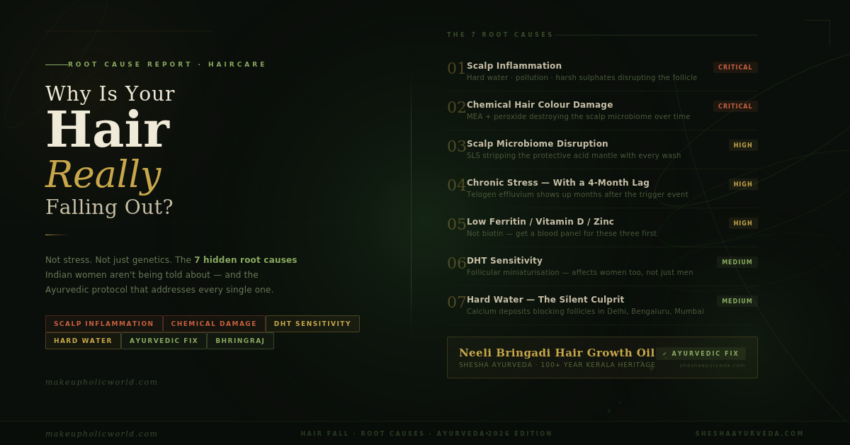
The 7 Root Causes of Hair Fall Nobody Is Talking About Honestly
1. Scalp Inflammation — The Silent Killer of Hair Follicles
Consumers are beginning to understand that strong, healthy hair depends directly on scalp balance — and as a result, increasingly seek treatments that address root causes instead of merely improving appearance.
Here’s what happens when your scalp is inflamed: the hair follicle is surrounded by immune cells that, during inflammation, mistakenly attack the follicle itself. This pushes hair follicles prematurely from the anagen (active growth) phase into the telogen (resting/shedding) phase. The result is diffuse shedding — hair falling out all over the scalp, not just at the temples or crown.
What causes scalp inflammation in India specifically?
- Hard water — India’s metro cities have some of the hardest tap water in Asia. The mineral deposits (calcium, magnesium) disrupt the scalp’s pH and block follicles.
- Pollution — Particulate matter settles on the scalp, triggers oxidative stress, and disrupts the scalp microbiome.
- Harsh surfactants in shampoos — Sodium lauryl sulphate (SLS) strips the scalp’s acid mantle, leaving it vulnerable to microbial overgrowth and inflammation.
- Chemical hair treatments — More on this below.
2. Chemical Hair Colour Is Causing More Hair Fall Than You Think
This is the connection most brands will never make — because it implicates their products.
When hydrogen peroxide (used in all permanent and semi-permanent hair colours) oxidises your natural melanin to allow new colour to deposit, it doesn’t just affect pigment. Scalp microbiome awareness is growing — consumers are understanding that harsh chemicals disrupt scalp health. The oxidative process degrades the disulphide bonds in the hair fibre and, with repeated use, penetrates the scalp barrier and triggers follicular inflammation.
MEA (monoethanolamine) — found in most “ammonia-free” hair colours — stays on the scalp longer than ammonia because it doesn’t evaporate. The prolonged alkaline contact disrupts the scalp’s naturally acidic pH (4.5–5.5), which is what keeps the microbiome balanced and the follicle environment healthy.
If you colour your hair regularly and are experiencing diffuse hair fall — these two facts are almost certainly connected. The hair colour didn’t cause immediate fallout. It caused cumulative, invisible scalp damage that’s now showing up as thinning.
3. The Scalp Microbiome Is Being Destroyed
The scalp shares many characteristics with facial skin — prone to dryness, irritation, and buildup — but with unique complexities: twice as many oil glands, ten times more hair follicles, and slightly thicker layers.
The scalp microbiome is an ecosystem of beneficial bacteria and fungi that protect the follicle, maintain pH, and prevent inflammatory pathogens from taking hold. When this ecosystem is disrupted — by sulphate-heavy shampoos, chemical treatments, hard water, or antibiotic overuse — the protective barrier fails. What follows is a cascade: dandruff, seborrheic dermatitis, follicle inflammation, and accelerated hair fall.
The Indian habit of washing hair daily (or near-daily) with harsh shampoos is one of the most scalp-microbiome-destructive habits possible. And most “anti-dandruff” shampoos compound the problem — they kill the pathogenic fungus but also strip beneficial bacteria, creating a dependency cycle.
4. Stress Is Affecting Your Hair Differently Now
Telogen effluvium — stress-triggered mass shedding — is not new. But the intensity and duration of stress that triggers it has changed. Chronic stress influences hair shedding cycles and scalp sensitivity, and in post-pandemic India, the baseline stress level for urban professionals has genuinely shifted higher.
What’s underreported: the lag time between stress event and shedding is 3–4 months. So the hair fall you’re experiencing today may be the physical manifestation of something that happened emotionally last quarter. This is why “but I’m not stressed now” doesn’t rule out stress as a cause.
5. Nutritional Deficiencies — Specifically Iron and Vitamin D
In India, iron deficiency anaemia affects a disproportionately high percentage of women. Hair fall is rarely just about the hair — it can be connected to thyroid imbalance, low ferritin levels, chronic stress, poor gut health, or scalp conditions like dandruff that go untreated for too long.
The specific nutrients most linked to hair fall in Indian women:
- Ferritin (stored iron) — Hair follicles need ferritin to produce keratin. Low ferritin = poor quality hair fibre + increased shedding.
- Vitamin D — Deficiency is endemic in India despite abundant sunlight, due to indoor lifestyles and SPF use. Vitamin D receptors are directly involved in follicle cycling.
- Zinc — Regulates DHT (the hormone implicated in androgenic hair loss). Deficiency accelerates follicular miniaturisation.
- Biotin — The most over-supplemented, least-deficient nutrient in hair fall. Most people taking biotin supplements don’t have a biotin deficiency. They have a ferritin problem.
Get a blood panel — specifically ferritin (not just haemoglobin), Vitamin D, zinc, and thyroid (T3/T4/TSH) — before spending money on supplements.
6. DHT Sensitivity — Not Just a Male Problem
Dihydrotestosterone (DHT) is the androgen responsible for follicular miniaturisation — the process by which hair follicles slowly shrink with each growth cycle until they stop producing visible hair. Androgenic alopecia (pattern hair loss) is driven by DHT.
In women, DHT sensitivity can manifest as hair thinning at the crown and parting, not the receding hairline pattern seen in men. PCOS, perimenopause, and post-pregnancy hormonal shifts all increase androgen activity, making Indian women in their 30s and 40s particularly vulnerable.
Ayurvedic ingredients like Bhringraj (Eclipta alba) have been shown in studies to inhibit 5-alpha reductase — the enzyme that converts testosterone to DHT — which is exactly how prescription drugs like finasteride work, just without the side effects.
7. Water Quality — The Problem Nobody Mentions
The “skinification” of haircare has led people to treat their scalp like facial skin, raising sensitivity to everything from shampoo ingredients to shower water quality. Rising distrust in municipal water systems has extended anxiety beyond drinking water into daily hygiene.
Hard water doesn’t just leave your glassware spotty. It deposits calcium and magnesium on the scalp and hair shaft, creates a barrier that blocks nourishing oils from penetrating, and raises scalp pH. Studies show that women who switch from hard to soft water see measurable improvements in hair strength and scalp health within weeks.
If you live in Delhi, Bengaluru, Mumbai, or Hyderabad — hard water is almost certainly a factor in your hair fall.
The Ayurvedic Approach to Hair Fall: Why It’s Clinically Relevant, Not Just Traditional
Ayurveda understood something about hair fall that modern trichology is only now formalising: healthy hair is a downstream outcome of a healthy scalp, and a healthy scalp is a downstream outcome of systemic balance.
The Ayurvedic approach to hair fall doesn’t treat it as a cosmetic problem. It treats it as a sign of imbalance — specifically, excess Pitta (heat, inflammation) disrupting the follicle environment, and Vata imbalance (dryness, irregular circulation) starving the follicle of nutrients.
The interventions that follow from this framework are remarkably aligned with what modern science now says works:
- Scalp oiling (abhyanga for the head) — Regular oil massage increases blood circulation to follicles, reduces cortisol, and delivers bioactive botanicals directly to the scalp. Studies confirm that mechanical scalp stimulation alone increases hair thickness.
- Cooling the scalp — Ayurvedic texts prescribe cooling herbs for Pitta-type hair fall. Modern science calls this reducing scalp inflammation. Same mechanism, different vocabulary.
- Gut health and hair health — Ayurveda has always connected digestive health (agni) to hair quality. The gut-skin-scalp axis is now an active area of dermatological research.
The Ingredients That Actually Work for Hair Fall
Bhringraj (Eclipta alba) — The King of Hair
No Ayurvedic ingredient has more documented history in hair care than Bhringraj. Research published in peer-reviewed journals has found Bhringraj extract to be comparable to minoxidil (the prescription hair fall treatment) in stimulating hair follicle growth in animal models — without the side effects of scalp irritation, initial shedding, and sexual dysfunction that minoxidil carries.
Bhringraj works via multiple mechanisms:
- Promotes the anagen (growth) phase
- Reduces DHT via 5-alpha reductase inhibition
- Improves blood circulation to follicles
- Has direct anti-inflammatory action on the scalp
Neeli — Indigofera tinctoria
Neeli (Indigo plant) is better known as a natural dye, but its role in Ayurvedic haircare goes far beyond colour. Traditional Kerala formulations used Neeli oil for scalp cooling, follicle strengthening, and addressing premature greying — all conditions that share an underlying inflammatory mechanism.
Amla (Indian Gooseberry) — The Antioxidant Anchor
Amla is one of the richest natural sources of Vitamin C. When applied topically, it neutralises free radical damage on the scalp from pollution and UV exposure, strengthens the hair shaft, and has been shown to inhibit the enzyme that converts testosterone to DHT — giving it genuine anti-hair-fall activity beyond its conditioning effects.
Sesame Oil Base — Why the Carrier Matters
The base oil in an Ayurvedic hair oil determines how deeply the actives penetrate. Sesame oil has one of the smallest molecular weights of any common carrier oil, meaning it genuinely penetrates the hair shaft and scalp rather than just coating the surface. It’s also anti-inflammatory, antifungal, and naturally UV-protective.
What to Use: Neeli Bringadi Hair Growth Oil by Shesha Ayurveda
Shesha Ayurveda has been making Ayurvedic formulations in Kerala for over 100 years — the kind of heritage that means Neeli Bringadi isn’t a product invented for a trend. It’s a formulation that’s been refined across generations.
Neeli Bringadi Hair Growth Oil combines:
- Bhringraj extract — for DHT inhibition and follicle stimulation
- Neeli (Indigofera) — for scalp cooling and strengthening
- Amla — for antioxidant protection and anti-hair-fall activity
- Sesame oil base — for deep penetration and delivery
The difference between this and a standard coconut-oil-with-herbs product: the botanicals aren’t infused casually. They’re processed according to traditional Kerala methods (kuzhambu and tailam preparation) that concentrate the bioactive compounds in a form the scalp can actually absorb.
No mineral oil. No synthetic fragrance. No silicones coating the shaft and creating the illusion of health while blocking the actives.
Your 4-Week Ayurvedic Hair Fall Protocol
Week 1–2: Scalp reset
- Oil twice weekly with Neeli Bringadi (30 minutes before wash, or overnight)
- Switch to a sulphate-free, low-pH shampoo
- Get the blood panel: ferritin, Vitamin D, zinc, TSH
Week 3–4: Routine and repair
- Continue oiling twice weekly
- Add an amla-based hair rinse (1 tsp amla powder in warm water, pour over scalp after shampooing, leave 5 minutes)
- If ferritin is low, start iron supplementation (with Vitamin C for absorption)
- Reduce wash frequency to 2–3 times per week if you’ve been washing daily
What to expect: Ayurvedic treatments are not instant. The hair growth cycle means you won’t see new growth for 8–12 weeks. What you’ll notice first (usually by week 4) is reduced shedding — fewer hairs in the drain, less on the brush. New growth comes after.
Frequently Asked Questions
Q: How much hair fall per day is normal? A: 50–100 strands per day is the accepted physiological range. If you’re consistently losing more than this — especially if you notice thinning at the parting, crown, or temples — it’s worth investigating.
Q: Does oiling hair really help with hair fall? A: Yes — but the mechanism matters. Oil on the hair shaft reduces hygral fatigue (damage from wet-dry cycles). Oil on the scalp, combined with massage, increases follicular blood circulation and delivers anti-inflammatory actives. The type of oil and how it’s applied determines how much benefit you actually get.
Q: Can hair fall from chemical hair colour be reversed? A: Scalp damage from chemical treatments can be reversed if caught early, before follicular miniaturisation has progressed. Stopping or reducing chemical exposure, switching to a declared-ingredient Ayurvedic hair colour like Nilini by Shesha Ayurveda, and following a scalp-nourishing protocol for 3–6 months can allow the scalp microbiome to recover and shedding to reduce.
Q: What is the fastest way to stop hair fall? A: Address the underlying cause — which you can only do after identifying it. A blood panel rules in or out nutritional causes. Stopping harsh chemical treatments removes one trigger. Reducing scalp inflammation through Ayurvedic oiling and sulphate-free washing addresses another. There is no single fastest fix because there is rarely a single cause.
Q: Is Bhringraj oil scientifically proven to help hair growth? A: Multiple peer-reviewed studies have found Bhringraj extract to promote hair growth in animal models, with some studies showing efficacy comparable to minoxidil. Human clinical trials are limited in scale, which is typical for traditional botanicals. The mechanism (DHT inhibition, follicle stimulation, anti-inflammatory action) is well-documented. It’s genuinely one of the best-evidenced Ayurvedic hair care ingredients.
Q: Can hard water cause hair fall? A: Hard water doesn’t directly cause follicular miniaturisation, but it contributes to scalp mineral buildup, pH disruption, and barrier damage that accelerates inflammation-driven hair fall. If you’re in a hard water area, a clarifying scalp wash monthly and an acidic rinse (diluted apple cider vinegar or amla water) after washing can help.
Q: Why is my hair falling out more after I started a “natural” shampoo? A: Natural shampoos can still contain sulphates, high-pH surfactants, or essential oils that irritate a sensitive scalp. Also, transitioning from silicone-heavy products reveals pre-existing damage that was previously masked. Check the ingredient list for sodium lauryl sulphate, sodium laureth sulphate, and any fragrance (parfum) — all potential irritants.
Renji is the founder of Makeupholicworld.com, a beauty and lifestyle platform active since 2012, and Co-Founder & COO of Shesha Ayurveda. She has been writing about beauty with evidence and attitude since before “clean beauty” was a search term.