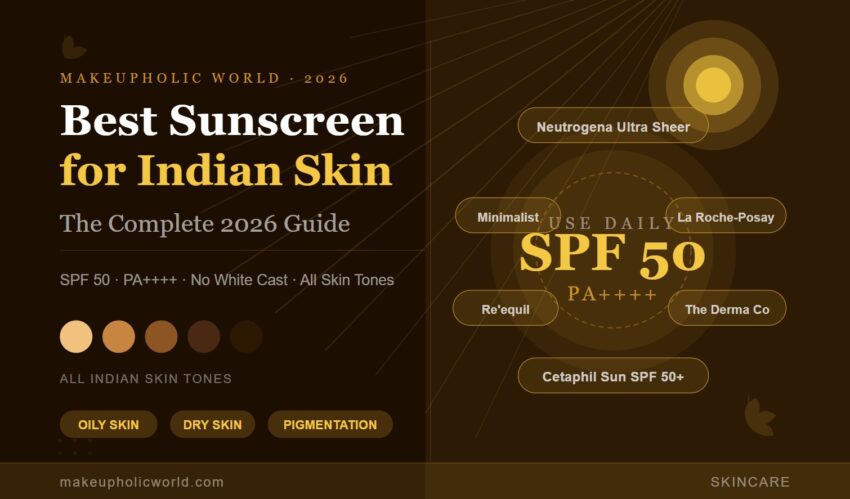
Makeupholic World · Skincare Guide · Updated May 2026
Best Sunscreen for Indian Skin 2026 — The Only Guide You Need
Tested picks for oily, dry, sensitive, and pigmentation-prone skin. PA++++ explained. White cast truth. The Ayurvedic repair step your routine is missing.
Why Indian Skin Needs Sunscreen Differently
The standard global sunscreen advice was not written with Indian skin in mind. Most international guidelines are based on fair skin research, fair skin concerns (burning), and temperate UV levels. Indian skin operates in a different reality entirely.
Indian skin has more melanin, which creates a common misconception — that darker skin does not burn and therefore does not need sunscreen. This is incomplete. Melanin does protect against burning to a degree. But it does not protect adequately against UVA-induced hyperpigmentation, melasma, uneven skin tone, and photoaging — which are the primary skin concerns of most Indian women and men. The tan you develop from skipping sunscreen is not a harmless colour change. It is UV damage accumulating in your skin cells.
Three uniquely Indian concerns make sunscreen even more non-negotiable here than in most parts of the world: hyperpigmentation (post-acne dark marks, melasma, sun spots), high humidity (which breaks down many sunscreen formulas faster), and year-round UV exposure with no real “safe” season.
SPF vs PA++++ — What Actually Matters for Indian Skin
This is where most Indians get it wrong. Everyone focuses on SPF. But for Indian skin, PA rating matters just as much — arguably more.
Understanding Your Sunscreen Label
Measures UVB protection — the rays that cause burning. SPF 30 blocks 97% of UVB. SPF 50 blocks 98%. The jump from SPF 30 to 50 is less significant than it sounds.
Measures UVA protection. UVA causes tanning, pigmentation, dark spots, and skin ageing. PA++++ is the maximum rating — critical for Indian skin which is highly prone to hyperpigmentation.
Means the formula protects against both UVA and UVB. Always look for this label alongside a PA rating for complete Indian climate protection.
Chemical sunscreens absorb UV, feel lightweight, no white cast. Mineral (zinc oxide/titanium dioxide) reflects UV, gentler for sensitive skin, may leave slight cast on deeper skin tones.
Best Sunscreens for Indian Skin 2026 — Ranked
These are the sunscreens I recommend for Indian skin — chosen across budget ranges, skin types, and concerns. All are available online in India.
The most reliably available, most widely tested sunscreen in India. Helioplex technology keeps the filters stable under India’s intense heat — a common failure point of cheaper sunscreens. The dry-touch formula absorbs quickly, leaves no residue, sits perfectly under makeup, and works across all Indian skin tones without greyness or cast. This is the benchmark every other sunscreen in this guide is measured against.
- Zero white cast on all Indian skin tones
- Available everywhere — pharmacies, Amazon, supermarkets
- Photostable in high heat and humidity
- Sits beautifully under foundation and tinted products
- Slightly drying for very dry skin types
- Fragrance included — sensitive skin should patch test
India’s best value clinical sunscreen. Minimalist’s transparent formulation philosophy means you know exactly what is in it — niacinamide for oil control, multi-vitamins for skin health, and a lightweight gel base that does not feel like you have applied anything at all. US in-vivo tested (real skin, not lab), which puts it ahead of many pricier competitors. A genuine oily skin hero that controls sebum while protecting.
- Niacinamide actively reduces oiliness while wearing
- No white cast — blends into all Indian skin tones
- Clinically tested in-vivo for actual SPF accuracy
- Excellent price-to-performance ratio
- Contains fragrance — patch test for sensitive skin
- Not fungal acne safe
The luxury benchmark and the most dermatologist-prescribed sunscreen in India for a reason. Mexoryl 400 technology provides protection up to 480nm UVA — significantly beyond what most Indian sunscreens cover. Particularly recommended for melasma, post-procedure skin (post-peel, post-laser), and anyone dealing with persistent pigmentation that does not respond to other sunscreens. The texture is genuinely invisible on skin — no trace, no cast, no transfer.
- Mexoryl 400 — next-gen ultra-long UVA protection
- Thermal spring water soothes reactive skin
- Top pick for melasma and post-procedure skin
- Zero white cast, ultra-light fluid texture
- Premium price point
- Limited availability — primarily online
The best budget sunscreen for dry Indian skin. The 1% hyaluronic acid base means this sunscreen doubles as a hydrating serum — solving the dry-skin paradox where most sunscreens leave tightness and flaking. Fragrance-free formula is also one of the few options suitable for very sensitive or reactive skin at an accessible price point. The aqua gel texture feels cooling on application and absorbs without residue.
- Fragrance-free — rare at this price
- Hyaluronic acid genuinely hydrates dry skin
- Lightweight gel absorbs without greasiness
- Excellent budget option with real PA++++ protection
- Not matte enough for very oily skin
- Contains silicones — avoid if fungal acne-prone
The dermatologist favourite for sensitive and acne-prone Indian skin. Oxybenzone and OMC (Octyl Methoxycinnamate) are the two UV filters most commonly linked to skin irritation, hormonal disruption concerns, and acne flare-ups. Re’equil removes both and reformulates around safer, gentler alternatives. Consistently dermat-prescribed for patients who break out from other sunscreens, or have reactive skin conditions like rosacea or eczema.
- Free from two most irritating common UV filters
- Works for skin that reacts to other sunscreens
- Matte finish — good for combination skin
- Widely available at pharmacies across India
- Slight white cast on very deep skin tones
- Texture is thicker than gel-based options
Cetaphil’s dermatological heritage shines in its sunscreen. Fragrance-free, non-comedogenic, and specifically formulated to not disturb the skin barrier — making it the go-to recommendation for post-procedure skin, eczema-prone skin, and anyone who uses prescription retinoids or actives. The light gel texture is slightly more hydrating than Neutrogena’s dry-touch without being heavy, positioning it well for normal-to-combination skin in less humid Indian climates.
- Fragrance-free — consistently kind to reactive skin
- Non-comedogenic — does not trigger breakouts
- Ideal alongside retinol, AHA/BHA routines
- Available at most Indian pharmacies
- Slightly dewy finish — may not suit very oily skin
- Not the lightest texture in this list
Quick Pick by Skin Type
Oily / Acne-Prone
Look for matte finish, non-comedogenic, gel-based formula. Oil-controlling actives like niacinamide are a bonus.
→ Minimalist SPF 50 PA++++Dry / Dehydrated
Choose cream or hydrating gel formulas with hyaluronic acid or ceramides. Avoid matte or dry-touch finishes.
→ Derma Co Hyaluronic GelSensitive / Reactive
Fragrance-free is non-negotiable. Avoid oxybenzone and OMC. Mineral formulas or pharma-grade chemical options.
→ Re’equil or CetaphilPigmentation / Melasma
PA++++ is essential. Iron oxides in the formula help block visible light which worsens melasma. Go premium here.
→ La Roche-Posay AntheliosUnder Makeup
Chemical sunscreens in fluid or gel form sit under foundation without pilling. Dry-touch and matte finishes work best.
→ Neutrogena Ultra SheerBudget Under ₹500
Affordable does not mean ineffective. Two options in this list are under ₹500 and deliver genuine PA++++ protection.
→ Derma Co or Neutrogena 30gThe White Cast Problem — Solved
White cast is the number one reason Indians avoid sunscreen. It is a legitimate complaint — nothing kills confidence faster than stepping out looking ashy. Here is exactly why it happens and how to avoid it completely.
White cast comes from mineral UV filters — zinc oxide and titanium dioxide — which physically sit on the skin and reflect light. They reflect all wavelengths, including visible light, which reads as white or grey on medium-to-deep Indian skin tones.
Chemical sunscreens do not cause white cast because they absorb UV rays through a chemical reaction rather than physical reflection. All six products in this guide are chemical or hybrid formulas chosen specifically to eliminate white cast on Indian skin tones ranging from wheatish to very deep brown.
5 Sunscreen Myths Indian Skin Believers Need to Drop
“Dark skin does not need sunscreen.” Melanin provides the equivalent of roughly SPF 4–6 natural protection. This is completely inadequate against India’s UV 11+ index. Dark skin is just as vulnerable to UVA-induced pigmentation, dark spots, and premature ageing.
“SPF 100 gives double the protection of SPF 50.” SPF 50 blocks 98% of UVB. SPF 100 blocks 99%. The difference is 1%. The extra weight and cost of SPF 100 formulas is not worth it — consistent reapplication of SPF 50 every 2 hours gives far better real-world protection.
“I do not need sunscreen on cloudy days.” Up to 80% of UV rays penetrate cloud cover. UVA — the ray responsible for pigmentation and ageing — passes through clouds, glass windows, and even some clothing. Daily sunscreen is non-negotiable regardless of weather.
“My foundation has SPF so I do not need a separate sunscreen.” You would need to apply 7–8 layers of foundation to achieve its labelled SPF. Foundation SPF is a marketing number, not a meaningful protection level. Always apply a dedicated sunscreen first.
“Applying more sunscreen gives more protection.” The amount matters — you need ¼ teaspoon (about 1.5ml) for your face alone. But applying double does not double protection. What matters is applying the correct amount and reapplying every 2 hours when outdoors.
After Sunscreen — Repairing Existing Sun Damage the Ayurvedic Way
Sunscreen prevents future damage. But what about the tan, pigmentation, and dark spots already on your skin? This is where modern skincare falls short — brightening serums take months, chemical peels are expensive and require downtime, and most over-the-counter de-tanning products give short-lived results.
The most effective skin-brightening and tan reversal treatment in India has existed for centuries — and it predates every serum, retinol, and niacinamide product on the market. Nalpamaradi Thailam is a classical Kerala Ayurvedic oil prescribed in the Sahasrayogam specifically for removing sun tan, reducing pigmentation, and restoring skin luminosity.
Nalpamaradi Thailam by Shesha Ayurveda — The Pre-Bath Tan Repair Ritual
Wild Turmeric, Vetiver, Four Sacred Ficus Barks, Red Sandalwood, Amla, and Manjistha — these are the hero ingredients of Nalpamaradi Thailam. Applied as a pre-bath massage oil, it reduces melanin production at the root, fades dark spots, reverses sun damage, and leaves skin visibly brighter within 7 days of daily use. It works on face and body — including stubborn areas like the neck, underarms, and arms where sun tan accumulates most.
Apply 4–6 drops of Nalpamaradi Thailam. Massage in circular motions for 5 minutes. Leave for 20–30 min then wash off before bathing.
Apply SPF 50 PA++++ sunscreen as the last step before leaving home. This two-step ritual — repair then protect — is the complete sun damage solution.
Visible reduction in tan and improved luminosity within 7 days. Significant dark spot fading in 3–4 weeks of consistent use.
Pregnancy, post-partum, babies from 3 months+, bridal skin prep, all Indian skin tones. 100% natural — no bleach, no chemicals.
Your Complete Morning Sun Protection Routine
Sunscreen is not a standalone step — it is the last step of a morning routine and the first line of defence for your skin every single day. Here is the complete sequence:
Apply 4–6 drops to face and/or body. Massage gently. Leave 20–30 min. This is your tan removal and dark spot repair step — done before everything else so it can absorb properly.
Use a gentle, non-stripping face wash. Washing off the oil with a mild cleanser ensures your skin is clean without stripping natural moisture.
If using Vitamin C, Niacinamide, or any active treatment serum, apply now on clean skin. Allow 2–3 minutes to absorb before the next step.
If your skin is dry or your sunscreen is not hydrating enough on its own, apply a lightweight moisturiser. Allow it to absorb before applying sunscreen on top.
Apply ¼ teaspoon (about 1.5ml) to the face alone. Do not forget ears, neck, and the back of hands. Apply 15–20 min before sun exposure for chemical sunscreens. Reapply every 2 hours when outdoors.
Once sunscreen has absorbed (2–3 min), apply foundation, tinted moisturiser, or CC cream as desired. Do not substitute makeup for sunscreen — apply sunscreen first, always.
Frequently Asked Questions
What SPF is best for Indian skin?
SPF 50 with PA++++ is the minimum recommended for Indian skin. SPF 50 blocks 98% of UVB rays, while PA++++ provides maximum protection against UVA rays — the primary cause of tanning, pigmentation, and premature ageing in Indian skin. Do not go below PA+++ for daily use in India’s UV conditions.
Which sunscreen does not leave a white cast on Indian skin?
Chemical sunscreens leave no white cast because they absorb UV rays chemically rather than physically. Top no-white-cast picks for Indian skin tones include Neutrogena Ultra Sheer SPF 50+, Minimalist SPF 50 PA++++, The Derma Co 1% Hyaluronic Sunscreen, and La Roche-Posay Anthelios Invisible Fluid. Avoid mineral-only sunscreens (zinc oxide / titanium dioxide) if white cast is a concern.
Is PA++++ better than PA+++ for pigmentation?
Yes. PA++++ is the highest UVA protection rating available. For Indian skin dealing with hyperpigmentation, melasma, dark spots, or post-acne marks, PA++++ is essential because UVA rays are the primary driver of these conditions. PA+++ is adequate for general daily protection; PA++++ is recommended if pigmentation is an active concern.
Can I use Nalpamaradi Thailam and sunscreen together?
Yes — they work as a sequential routine, not together at the same time. Apply Nalpamaradi Thailam before your bath as a pre-bath massage oil for tan removal and skin brightening. Wash it off, complete your morning routine, and apply sunscreen as the final step before leaving home. The oil repairs existing damage; the sunscreen prevents new damage.
Should I apply sunscreen indoors?
Yes, particularly if you sit near windows. UVA rays penetrate glass and can cause pigmentation and ageing even during indoor activity. If you are far from windows and do not step outside, one morning application of SPF 50 is sufficient. Blue light from screens is a minor concern by comparison — standard SPF 50 PA++++ is adequate protection.
How do I fix the tan I already have?
For existing tan and dark spots, use Nalpamaradi Thailam as a daily pre-bath treatment. This classical Ayurvedic oil from Kerala uses Wild Turmeric, Vetiver, and Ficus bark to reduce melanin and reverse sun damage. Apply daily before bathing, follow with sunscreen after, and visible results appear within 7–10 days.
Which sunscreen is best for oily skin in Indian summer?
Minimalist SPF 50 PA++++ is the best oily skin sunscreen for Indian summer. It is a lightweight gel with niacinamide for oil control, no greasiness, zero white cast, and has been clinically tested in the US for actual SPF accuracy. Neutrogena Ultra Sheer is the second-best option for its water resistance and availability.
Found This Guide Useful?
If you are dealing with existing tan, dark spots, or pigmentation from years of sun exposure without sunscreen — add Nalpamaradi Thailam to your morning routine. It is the Ayurvedic step that works upstream of everything else.
Shop Shesha Ayurveda Nalpamaradi Thailam →