Let me say something the beauty industry rarely admits: the fairness cream generation did more damage to Indian skin than any amount of sun exposure ever could.
For decades, we were sold the idea that the goal was lighter skin. The real goal — the one nobody was talking about — was even skin. Healthy, radiant, unpatchy skin. Those are very different problems with very different solutions. And confusing them meant that millions of Indian women spent years applying hydroquinone, mercury-laced creams, and steroid-containing “fairness” products that gave short-term results and long-term consequences — thinned skin, rebound hyperpigmentation, and a damaged barrier that made everything worse.
In 2026, the conversation has finally shifted. Hyperpigmentation is now understood as a skin health issue, not a skin colour issue. And the science behind treating it has caught up with what Ayurvedic medicine has known for over a thousand years.
This is that story.
Why Indian Skin Is Specifically More Vulnerable to Hyperpigmentation
Indian skin is beautiful. It is also, by its own biology, more prone to dark spots than lighter skin tones. Understanding why is the first step to treating it correctly.
The melanin factor:
Our skin gets its colour from melanin, produced by cells called melanocytes. Indian skin doesn’t have more melanocytes than lighter skin — the number is roughly the same across all humans. What’s different is how active those melanocytes are. In skin with higher baseline melanin (brown to deep brown), the melanocytes are already closer to their maximum production capacity. Any trigger — sun exposure, inflammation, hormonal shift — pushes them over the edge into overproduction.
This is why a pimple leaves a dark mark on Indian skin that can last months, while the same pimple on lighter skin fades in days. The biological response is the same; the melanin amplification is not.
The sun exposure reality:
India receives some of the highest UV radiation of any inhabited region on earth. UV-A and UV-B rays are the primary triggers for melanin overproduction. Combined with the melanin sensitivity above, this means that Indian skin — even with SPF — is fighting a harder battle against photodamage than most global skincare products were designed for.
The post-inflammatory response:
Brown skin has more natural pigment or melanin than Caucasian skin, making us more susceptible to skin pigmentation. Post-inflammatory hyperpigmentation (PIH) — the dark marks left behind by acne, rashes, insect bites, or even aggressive skincare — is far more pronounced and persistent in Indian skin for exactly this reason.
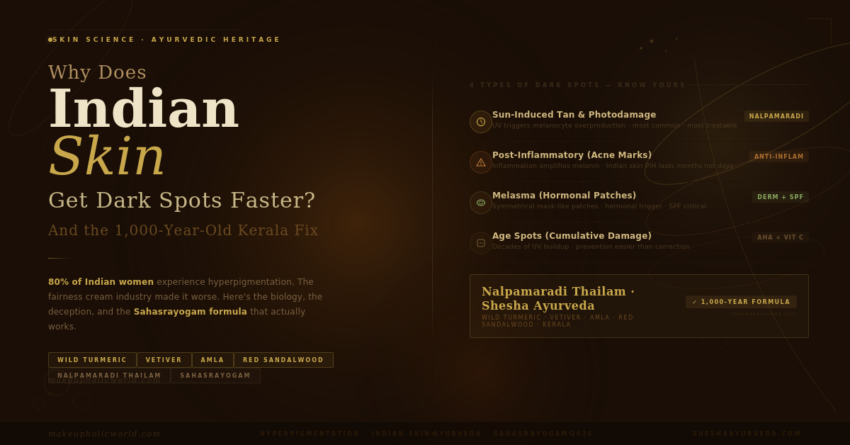
The 4 Types of Dark Spots on Indian Skin (And Why They Need Different Approaches)
Most people talk about “dark spots” as if they’re all the same thing. They’re not. Treating the wrong type of hyperpigmentation with the wrong approach is why so many people cycle through products without results.
Type 1: Sun-Induced Hyperpigmentation (Solar Lentigines / Tan)
What it looks like: Generalised darkening of exposed areas — face, neck, arms. Can appear as an overall dullness or as distinct flat spots on the cheeks and nose.
What causes it: UV exposure activating melanocytes. The “tan” most people try to remove is melanin deposited in the upper layers of the skin as a protective response.
What works: Melanin-inhibiting botanicals (curcumin, Vitamin C, kojic acid), gentle exfoliation to remove pigmented cells, and strict SPF. This is the most treatable type — and the one Nalpamaradi Thailam was specifically formulated for.
Type 2: Post-Inflammatory Hyperpigmentation (PIH)
What it looks like: Dark marks or patches at the exact site of a previous acne spot, wound, rash, or skin irritation. Can be brown, reddish-brown, or near-black.
What causes it: The inflammatory response triggers melanocyte activity at the site of injury. The mark isn’t a scar — it’s residual pigment.
What works: Anti-inflammatory ingredients (Vetiver, sandalwood, aloe), barrier repair to prevent further inflammation, and melanin inhibitors. Patience — PIH can take 3–6 months to fully resolve.
Type 3: Melasma
What it looks like: Symmetrical patches — typically across both cheeks, the forehead, or the upper lip. Often described as a “mask” of pigmentation.
What causes it: Hormonal triggers (pregnancy, contraceptive pills, perimenopause) combined with UV exposure. Melasma sits deeper in the dermis than surface tan and is the most stubborn type to treat.
What works: Sun protection is non-negotiable. Topical treatments help but work slowly. Ayurvedic blood-purifying herbs like Manjistha (Rubia cordifolia) are traditionally used specifically for this type. Always get a dermatologist consultation for severe melasma.
Type 4: Age Spots (Seborrheic Keratoses / Liver Spots)
What it looks like: Slightly raised, well-defined brown spots — typically on the face, hands, and chest. More common after 40.
What causes it: Cumulative UV damage over decades combined with the natural slowing of skin cell turnover with age.
What works: Consistent use of AHA exfoliants, Vitamin C, and melanin inhibitors. Prevention is easier than correction — sunscreen from your 20s is the best anti-ageing investment available.
Why Skin Brightening Creams Are Making Your Hyperpigmentation Worse
Here’s the truth about most commercial skin brightening products in India:
Hydroquinone: Once the gold standard of hyperpigmentation treatment, hydroquinone works by killing melanocytes. It is effective short-term. The problems: rebound hyperpigmentation when you stop using it (your skin compensates for the killed cells), potential carcinogenicity with long-term use, and a now well-documented tendency to cause ochronosis (permanent bluish-black darkening) with prolonged application in darker skin tones. The focus in 2026 is moving away from irritation and towards efficacy with tolerance — while hydroquinone was once the gold standard, its side effects have pushed the industry towards safer, plant-derived alternatives that inhibit tyrosinase without the backlash.
Mercury-containing creams: These are illegal in India but still found in grey-market products. Mercury interferes with melanin synthesis but is a potent neurotoxin. Do not use any skin lightening cream that doesn’t disclose its full ingredient list.
Steroid-based brightening creams: A disturbingly common formulation in Indian pharmacy brands. Steroids (like betamethasone or clobetasol) reduce inflammation and temporarily lighten skin — but cause skin thinning, telangiectasia (visible capillaries), steroid-induced acne, and permanent barrier damage with prolonged use. Many people using these don’t know they contain steroids because the product is marketed as a “fairness cream.”
The ingredient transparency problem again: Just as with hair colour, Indian skin brightening products don’t have to disclose what’s actually in them in plain language. If you don’t recognise an ingredient and can’t find information about it, that’s a red flag — not a sign that it’s exotic and effective.
What Ayurveda Got Right About Hyperpigmentation (That Science Is Now Confirming)
Ayurvedic medicine classified hyperpigmentation primarily as a Pitta disorder — excess heat and inflammation creating toxic accumulation in the blood (Rakta dhatu) that manifests as skin discolouration. The treatment protocol focused on three simultaneous interventions:
- Cooling and anti-inflammatory topicals — to reduce the inflammatory trigger for melanin overproduction
- Melanin-inhibiting botanicals — specifically ingredients that work on the tyrosinase enzyme
- Blood purification — addressing the internal triggers of chronic pigmentation
What’s remarkable is how precisely this maps to what modern dermatology now recommends: reduce inflammation, inhibit tyrosinase activity, address hormonal and systemic triggers. The Ayurvedic physicians of the Sahasrayogam period were solving the same problem with the same mechanism — just in different vocabulary.
Nalpamaradi Thailam: The Science Behind a 1,000-Year-Old Formula
Nalpamaradi Thailam is documented in the Sahasrayogam — a classical Sanskrit text on Ayurvedic medicine compiled in Kerala. For centuries, this oil was used in pre-wedding beauty rituals across Kerala, applied for weeks before auspicious occasions to achieve naturally radiant, tan-free skin.
The formulation isn’t random. Every ingredient has a specific, documented mechanism:
Wild Turmeric (Kasturi Manjal / Curcuma longa):
The primary brightening agent. Curcumin — the active compound in turmeric — is a natural tyrosinase inhibitor. Tyrosinase is the enzyme that converts the amino acid tyrosine into melanin. Block tyrosinase, and you reduce melanin production at the source. Wild turmeric is rich in curcumin, a natural compound scientifically documented to inhibit melanin production, reduce sun-induced pigmentation, and fade deep-seated tan. Unlike regular kitchen turmeric, wild turmeric (Kasturi Manjal) has a higher concentration of brightening compounds and — crucially — does not permanently stain the skin yellow the way culinary turmeric can.
Vetiver (Vetiveria zizanioides):
Vetiver’s role is dual — anti-inflammatory and brightening. Its natural skin-lightening compounds work on the post-inflammatory pathway, making it specifically effective for PIH (the dark marks left after acne or wounds). It also has a deep cooling effect on the skin, directly addressing the excess Pitta that Ayurveda identifies as the root of pigmentation.
Amla (Indian Gooseberry / Emblica officinalis):
Amla is one of the richest plant sources of Vitamin C on earth — far exceeding lemon or orange. Amla accelerates collagen synthesis, neutralises free radicals from UV exposure, and visibly brightens the complexion. Vitamin C also inhibits melanin production by reducing the oxidation of DOPA (an intermediate in the melanin synthesis pathway) — giving it a brightening mechanism separate from and complementary to curcumin’s tyrosinase inhibition.
Red Sandalwood (Rakta Chandana):
Anti-inflammatory, antioxidant, and mildly astringent. Red Sandalwood addresses the skin’s reactive response to both UV damage and post-inflammatory triggers, and has been used in Ayurvedic skin formulations for over 2,000 years as a complexion-enhancing ingredient.
Sesame Oil Base:
The choice of base oil is not incidental. Sesame oil has one of the smallest molecular weights among carrier oils, meaning it actually penetrates the skin barrier rather than sitting on the surface. The active botanical compounds are carried deep into the epidermis — where melanin is produced — rather than just conditioning the surface.
How to Use Nalpamaradi Thailam: The Pre-Bath Ritual
The traditional application of Nalpamaradi Thailam is as a pre-bath ritual — not a leave-on overnight treatment.
Step 1: Take the required amount and apply all over the face and body, massaging gently in circular motions. The massage itself is significant — it stimulates lymphatic drainage and increases blood circulation to the skin surface, improving herb absorption.
Step 2: Leave on for 20–30 minutes. This is the active treatment window — long enough for the curcumin and Vetiver compounds to interact with the melanocytes.
Step 3: Wash off thoroughly with warm water. Follow with your regular cleanser if needed.
Step 4: Apply sunscreen if going outdoors. This is non-negotiable when using any melanin-inhibiting treatment. The treatment works by reducing melanin production — but UV exposure will immediately trigger more production if skin is unprotected.
For best results: 3–4 times per week, consistently for 6–8 weeks. Ayurvedic treatments are cumulative, not instant. The mechanism of action (melanin inhibition and cell turnover) takes time to show visible results. Most users see measurable change in skin tone uniformity by week 4–6.
The Brightening Routine That Actually Works for Indian Skin in 2026
Morning:
- Gentle, sulphate-free cleanser
- Vitamin C serum (to boost Amla’s brightening effect if using Nalpamaradi in PM)
- Lightweight moisturiser
- SPF 50 PA+++ minimum — every single day, regardless of weather
3–4 times per week (pre-bath):
- Nalpamaradi Thailam massage — 20–30 minutes on face and body
- Wash off, follow with cleanser
- Allow skin to dry fully before applying SPF
Weekly:
- Gentle exfoliation (AHA or enzyme-based) to clear pigmented dead cells and allow brightening actives to penetrate more effectively
- A Kasturi Manjal face mask for targeted spot treatment
Explore Nalpamaradi Thailam by Shesha Ayurveda → Authentic Sahasrayogam formula. Made in Kerala. AYUSH certified.
Frequently Asked Questions
Q: Why do Indian skin tones get dark spots more easily than fairer skin? A: Indian skin has highly active melanocytes — the cells that produce pigment. Any trigger (UV exposure, inflammation, hormonal change) causes these cells to overproduce melanin, leaving a dark mark. The same stimulus that causes temporary redness in lighter skin causes a lasting dark spot in Indian skin due to this melanin amplification effect.
Q: How long does it take for dark spots to fade with Ayurvedic treatment? A: Surface tan from sun exposure can show visible lightening in 4–6 weeks with consistent use of melanin-inhibiting treatments like Nalpamaradi. Post-inflammatory hyperpigmentation (PIH) from acne can take 2–4 months. Melasma is the most stubborn and may take 6–12 months. Consistency and daily SPF are non-negotiable for all types.
Q: Is turmeric actually effective for skin brightening, or is it a myth? A: The science is real. Curcumin — turmeric’s active compound — inhibits tyrosinase, the enzyme that controls melanin production. Multiple peer-reviewed studies confirm its depigmenting activity. However, effectiveness depends on which type of turmeric is used (wild/Kasturi Manjal is significantly more potent than culinary turmeric), the concentration, and the delivery system (oil-based carriers penetrate more effectively than water-based formulations).
Q: Can Nalpamaradi Thailam be used on the body as well as the face? A: Yes — it was traditionally used as a full-body pre-bath treatment. It’s particularly effective on areas prone to tan and unevenness: neck, arms, elbows, knees, and inner thighs. The same massage-and-wash-off method applies.
Q: What’s the difference between Nalpamaradi Thailam and regular turmeric face packs? A: A homemade turmeric pack uses raw turmeric or turmeric powder in a water-based or milk-based medium. Nalpamaradi Thailam processes wild turmeric and multiple complementary herbs in sesame oil using traditional Kerala methods (tailam preparation), which concentrates the bioactive compounds and delivers them in a fat-soluble carrier that penetrates the skin far more effectively than water-based formulations. The synergy between Wild Turmeric, Vetiver, Amla, and Red Sandalwood also provides mechanisms that a simple turmeric pack cannot.
Q: Is it safe to use Nalpamaradi Thailam every day? A: It is safe for most skin types, but 3–4 times per week is optimal. Wild Turmeric can leave a temporary yellow tint on very fair skin with daily use, and daily application on very oily skin can cause buildup. Apply SPF without exception on days you use it — melanin inhibitors increase UV sensitivity while they’re working.
Q: Will Nalpamaradi Thailam make my skin fairer? A: No — and that’s an important distinction. Nalpamaradi Thailam does not alter your natural skin colour. It removes photodamage, tan, and post-inflammatory pigmentation to restore your skin to its natural, even tone. Skin that is uniformly its own shade looks radiant and healthy. That’s the goal. Your natural complexion, unpatchy and undamaged, is the result.
Renji is the founder of Makeupholicworld.com, a beauty and lifestyle platform active since 2012, and Co-Founder & COO of Shesha Ayurveda. She has been reviewing beauty products for over a decade and is particularly invested in the science behind Ayurvedic formulations — because heritage without evidence is just nostalgia.